How to Make Your Social Media Content 10X Better: 15 Practical Steps

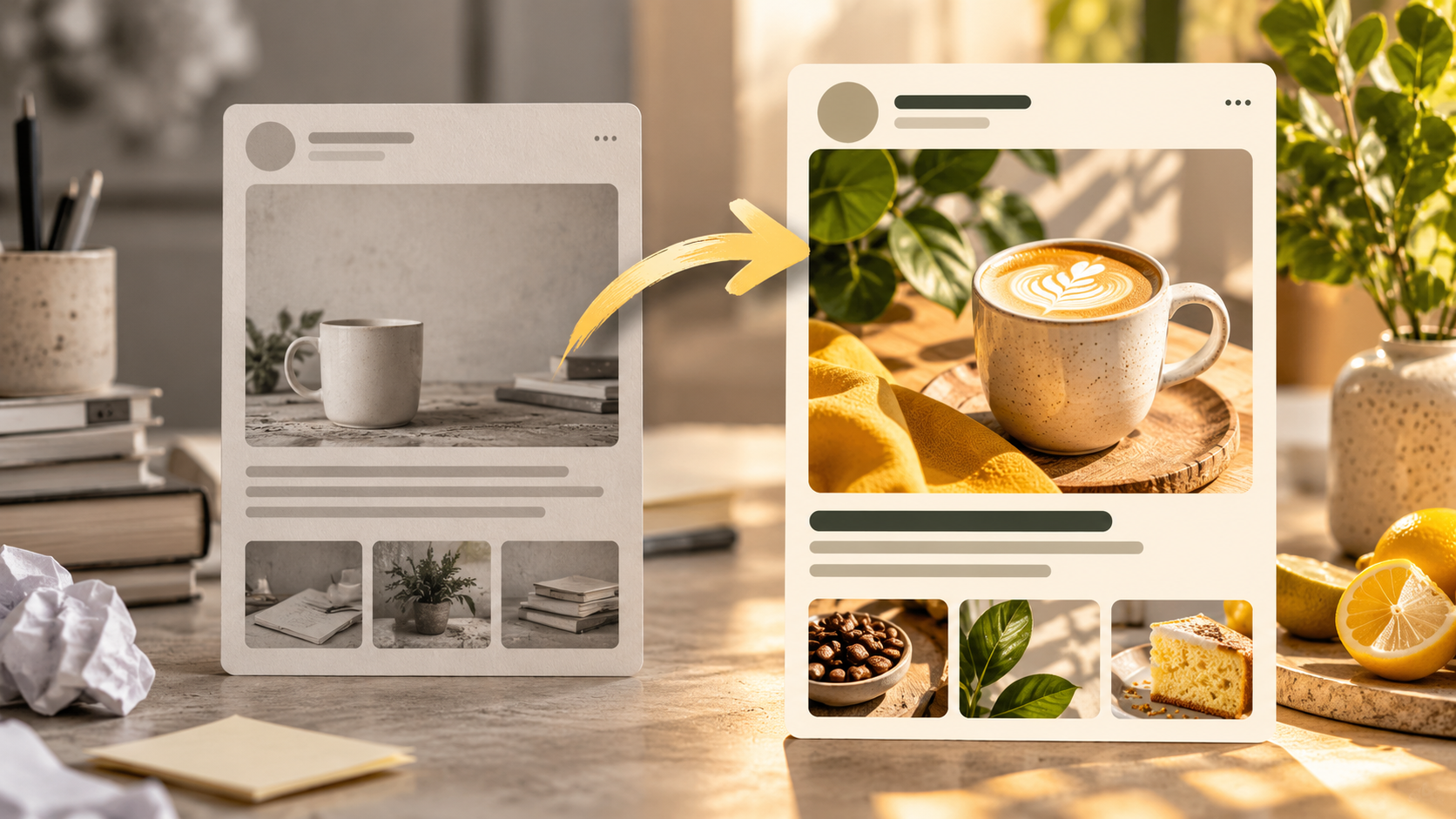
“Just post consistently” is not enough. If the topic is weak, the opening is vague, or the visual is confusing, posting more often only creates more content people scroll past.
Better content does not require a studio, viral dance, or six hours in Canva. It comes down to a stronger topic, better hook, and fitting visual.
These 15 practical steps can make your posts clearer, more useful, and easier for the right people to remember.
Quick Answer
Better social media content comes down to three things: a stronger topic, a clearer hook, and a visual that helps the idea land. You do not need a studio or viral trend — start by fixing your post’s weakest point, then add a personal entry point, proof, and one useful next step.
Table of Contents
What Does “10X Better” Actually Mean?
“10X better” is not a promise of ten times the reach or sales. It means your post becomes noticeably clearer, more useful, and better connected to your business.
One post does not need all 15 steps. Fix its weakest point first. Sometimes the opening is the problem. Other times, the idea needs work before the design.
Part One: Choose a Stronger Topic
A clever hook cannot rescue a topic your audience does not care about. Start with a real question, problem, goal, or conversation.
1. Start With a Proven Topic
Do not invent every idea from scratch. Review your best-performing posts, customer questions, and industry conversations, then adapt a proven topic using your own experience, examples, and voice. Borrow the pattern, not another creator’s post.
2. Look for Outlier Posts
An outlier performs noticeably better than your usual content through saves, shares, comments, profile visits, or inquiries. Ask what made it different: the topic, hook, format, timing, emotion, or call to action? Repeat that useful pattern with a new message.
3. Give It a Personal Entry Point
Ground the post in something you experienced, noticed, learned, or heard from a customer. Instead of “Three ways to improve customer service,” try: “A customer asked me this last week, and it completely changed the advice I gave her.” Personal stories make familiar advice memorable.
4. Make It Useful Within 24 Hours
Teach one idea your reader can try within the next day, such as a question to ask, setting to check, or mistake to fix. One clear lesson is often more useful than a giant list people save and never use.
5. Build a Problem Bank
Keep a running list of customer questions, worries, objections, and misunderstandings. Add to it after calls, emails, and DMs. Their real wording often creates stronger topics than polished marketing language.
If you need more places to find useful topics, read What Should I Post When I Have No Ideas?.
Part Two: Write a Stronger Hook
Your hook is the first line people see. It should give them a clear, honest reason to keep reading.
6. Make a Stronger Promise
Tell readers exactly what they will gain. Replace “A few marketing thoughts” with “Three changes that can make your next service post easier to understand.” Specific promises feel more useful, but the post must deliver what the first line promises.
7. Add Proof Early
Lead with a real number, result, date, customer question, or first-hand experience. Use only details you can support, and add context. “This post reached 5,200 local people” means more when your normal reach is 900.
8. Create a Curiosity Gap
Introduce a question the reader wants answered, such as the common advice that failed or the small change that made a difference. Then answer it. If the caption never pays off the hook, curiosity becomes clickbait instead of trust-building content.
9. Try Newsjacking When It Is Relevant
Newsjacking means adding your perspective to a timely platform update, local event, seasonal issue, or industry announcement. Explain why it matters and give readers a practical takeaway. Skip news that does not connect naturally.
10. Challenge the Usual Advice
A thoughtful contrarian hook questions a common belief, then explains why. For example: “Posting every day is not always the best way to grow your business.” Support the different view with experience, examples, or evidence. Without proof, it is just a hot take.
Part Three: Choose a Visual That Helps the Idea Land
The visual and opening lines should feel like one idea, not two pieces competing for attention.
11. Pair the Visual With the Hook
Plan the first few lines and visual together. The image can reinforce the promise, show the problem, reveal proof, or create curiosity. If the caption says “The window mistake costing homeowners natural light,” show the window or the problem, not a vague stock photo.
12. Show the Idea Fast
Someone should understand the subject at a glance. Use one focal point, readable text, and enough contrast for a phone screen. If the graphic needs a paragraph of explanation, simplify it.
13. Match the Format to the Message
Choose the format based on what the message needs:
 Use a carousel for steps, comparisons, or storytelling.
- Use an infographic for a compact process or helpful data.
- Use a Reel for movement, personality, demonstrations, or behind-the-scenes work.
- Use a strong photo when the project, product, person, or result is the proof.
14. Get Comfortable With Useful Video
Aim for one useful video each week if that is realistic. Demonstrations, walkthroughs, testimonials, FAQs, project clips, and simple skits can all work. Film vertically, get to the point, add captions, and show something your customer wants to understand.
15. Break the Pattern
Earn a second look with a custom caricature, recurring prop, unusual camera angle, recognizable series, or signature design style. Different should still feel like your business. The goal is recognition, not randomness.
For more guidance on creating content that genuinely comes from your business, read What Counts as Original Content on Facebook and Instagram?.
A Simple Content Upgrade You Can Try Today
Choose one post you were already planning and give it this quick upgrade:
- Connect it to one real customer problem.
- Add a personal observation, example, or piece of proof.
- Write a first line that promises a clear takeaway.
- Choose the format that explains the idea most naturally.
- End with one useful next step or call to action.
That can make a basic post more purposeful without rebuilding your entire strategy today.
Check Your Social Media Foundation
Stronger posts help, but they cannot do all the work if your profile is incomplete or confusing.
Take my free Two-Minute Social Media Visibility Checkup to see whether your social media is helping customers find, remember, and trust your business. It will show you what is working and what may need more attention.
Is your social media foundation working?
Take my free Two-Minute Social Media Visibility Checkup to see whether your social media is making it easy for customers to find, remember, and trust your business.
More Social Media Resources
- What Should I Post When I Have No Ideas?: Find ideas inside your everyday work.
- How Often Should a Small Business Post on Social Media?: Choose a sustainable posting schedule.
- Facebook and Instagram Tips for Small Businesses: Strengthen your profiles, posts, and engagement.
- What Counts as Original Content on Facebook and Instagram?: Create authentic posts without starting from scratch.
When You Would Rather Hand It Off
These steps are doable. Applying them consistently while running your business is the hard part.
At Full Bloom Social Media, I help established small businesses in Northern Utah turn their knowledge, stories, and everyday work into purposeful content. I handle the planning, writing, design coordination, scheduling, community care, and analytics so your content stays consistent without taking over your day.
If you want content that sounds like your business and supports your marketing goals, I would be happy to talk.
Ready for content that sounds like you?
Let’s create a social media presence that feels genuine, stays recognizable, and gives your business room to bloom. 🌻